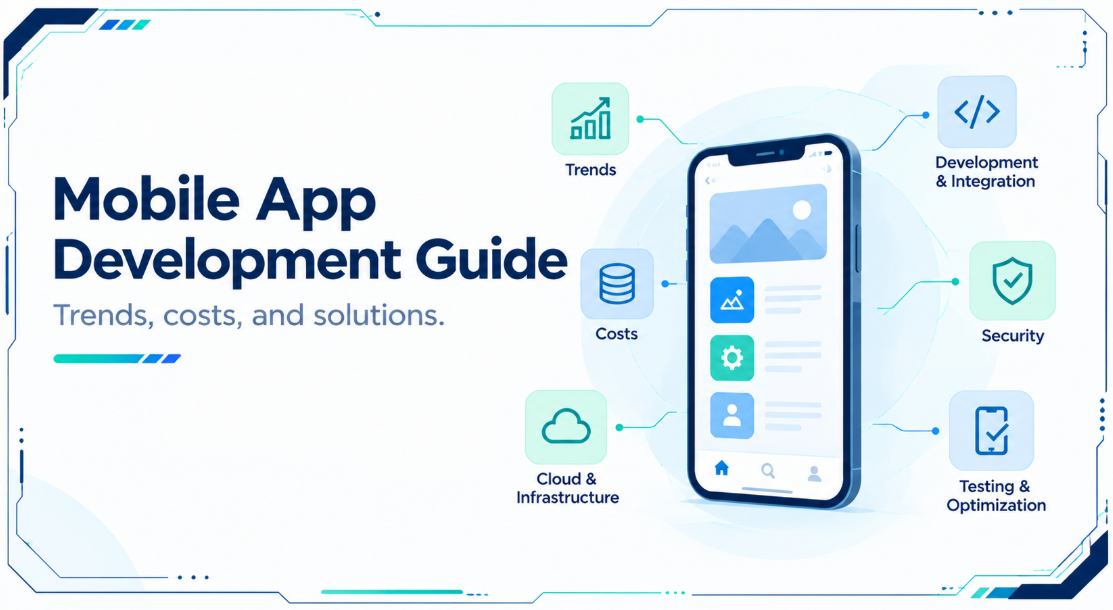
Mobile applications are no longer merely digital channels; they have become essential tools used for customer communication, process automation, and income generation. Now, enterprises are rethinking how to build mobile experiences and what to utilize when developing mobile platforms due to the emergence of AI technologies, growing customer expectations, and the demand for making mobile applications scalable. Therefore, the choice of a Mobile Application Development Company has become a critical organizational decision for companies seeking to compete successfully.
But what is the process of creating a contemporary app, and how can organizations discover what technologies, costs, and security measures should be considered when investing in mobile development?
Top Trends of Mobile App Development Services for Businesses
The world of apps is changing fast, and new technologies are changing the way apps are made, built, and used. The following factors reshape how app development services become beneficial for users:
- Intelligent helpers, custom suggestions, and chats with AI agents are making apps better at meeting what users need.
- Smart tools can take care of tasks that happen over and over, help with customer support, and make work easier when they are used properly.
- Tools like Flutter and React Native let companies develop apps for both phones and tablets using the same code.
- Devices that connect to the internet, watches, and virtual reality are making inroads in healthcare, retail, and more.
- Apps that put privacy first use ways to check who is using them, show how data is handled, and use AI in a good way.
For companies, the main goal is not to use all tech. It is to find the ideas that fix problems and offer real benefits.
What Users Expect and How to Choose the Right Approach For Mobile Application Development
Whenever using the most creative app, difficulties may arise due to navigational issues and lack of reliability. Legacy users look for quick uploads, easy-to-use interfaces, customized content, and smooth transactions. In such cases, biometric authentication, notifications in real time, user-friendly design, and customer service enhance user experience more effectively. Thus, before developing the application, enterprises must evaluate whether the targeted users’ expectations are met or not.
Furthermore, the right technology depends on the application’s purpose, the audience it aims to reach, the performance it must deliver, and how it will be maintained in the future.
For instance,
- Native development using Swift and SwiftUI for iOS or Kotlin for Android is a choice for applications that need deep platform integration.
- In contrast, Flutter and React Native can be useful for businesses that want an experience, on many platforms and who want to share development resources.
A reliable mobile application development firm should evaluate these trade‑offs before recommending a solution. Whether a business needs Android app development services, iOS app development services, or a cross‑platform application, the decision should reflect the product’s requirements rather than following technology trends alone.
Backend architecture matters as much as the frontend. Cloud infrastructure, APIs, databases, and third‑party integrations must support performance and allow the application to grow in the future.
The App Success Triad: Features, Security, and Scalability
A successful mobile application incorporates features that are necessary, secure, and scalable. Several factors impact business in mobile app development, as discussed below:
- Primary features include user authentication, a personalized home page, payments, analytics and notifications, and receiving updates in real time.
- Enable AI-powered mobile app development for suggestions, consultations, and integration of CRM and ERP solutions.
- Build scalable applications for simplified usage of the MVP, making it possible to confirm the existence of market demand for the future application and allow for better digital product iteration.
- Ensure security and compliance with encryption, secure APIs, restrictive access, vulnerability testing, and the overall establishment of policies and procedures for the retention of data that should comply with different regulations such as GDPR, PCI DSS, HIPAA, and others.
- Utilize digital product development services that are capable of evolving and handling growing volumes and additional integrations without changing their core architecture.
Pricing for Mobile Application Development in 2026
There is no fixed price for building a mobile application. The cost changes based on:
- How complicated the features are
- Number of platforms the app will work on
- What type of user interface and user experience are designed
- Which kind of back-end systems are needed
- Extra features that need to be added
- How secure the app needs to be, and
- What kind of support is required after it is launched
A simple version of the app that focuses on the important features usually costs less than a complex app that is made for large organizations and has smart AI features and many different systems connected together. Businesses should ask for an estimate that includes everything from planning and designing to building, testing, deployment, and helping after it is done.
Using custom mobile app development services makes sure that the app works the way a business needs it to, with the structure and features. This way, the app doesn't have parts that are not needed, but it still leaves space for growing and adding more things in the future.
Final Remarks
Successful mobile application development involves more than just selecting a platform or rolling out a product. It requires deep knowledge of the users, business goals, technical requirements, and the long-term objectives of the product.
Xcelore mobile app development services help organizations deal with these issues by providing app engineering, custom development, AI integration, cross-platform apps, modernization, and maintenance services. With a proper strategy, enterprises can create apps that improve user experience, optimize business processes, and maintain sustainable digital growth.
Frequently Asked Questions
- What is the timeline for mobile app development?
The time taken for the project mainly depends on different factors like the scope of the app, complexity, integration, testing, and the number of team members working on the development. Defining an MVP and giving priority to the important features can help make the delivery timeline more stable. - What makes it essential for businesses to partner with a mobile app development company?
Experienced partners for mobile development help you with the selection of technology, product design, engineering, integration, quality assurance, and security for creating new applications or modernizing existing ones with full scope for continuous improvements and successful outcomes.
Comments
Join the discussionNo comments yet. Be the first to comment.
Development
Understand how mobile apps, web apps, software, and products are developed now with the use of AI in their core operations. Find out how it is reshaping the way businesses manage their operations and grow in the industry while staying compliant and governed.